
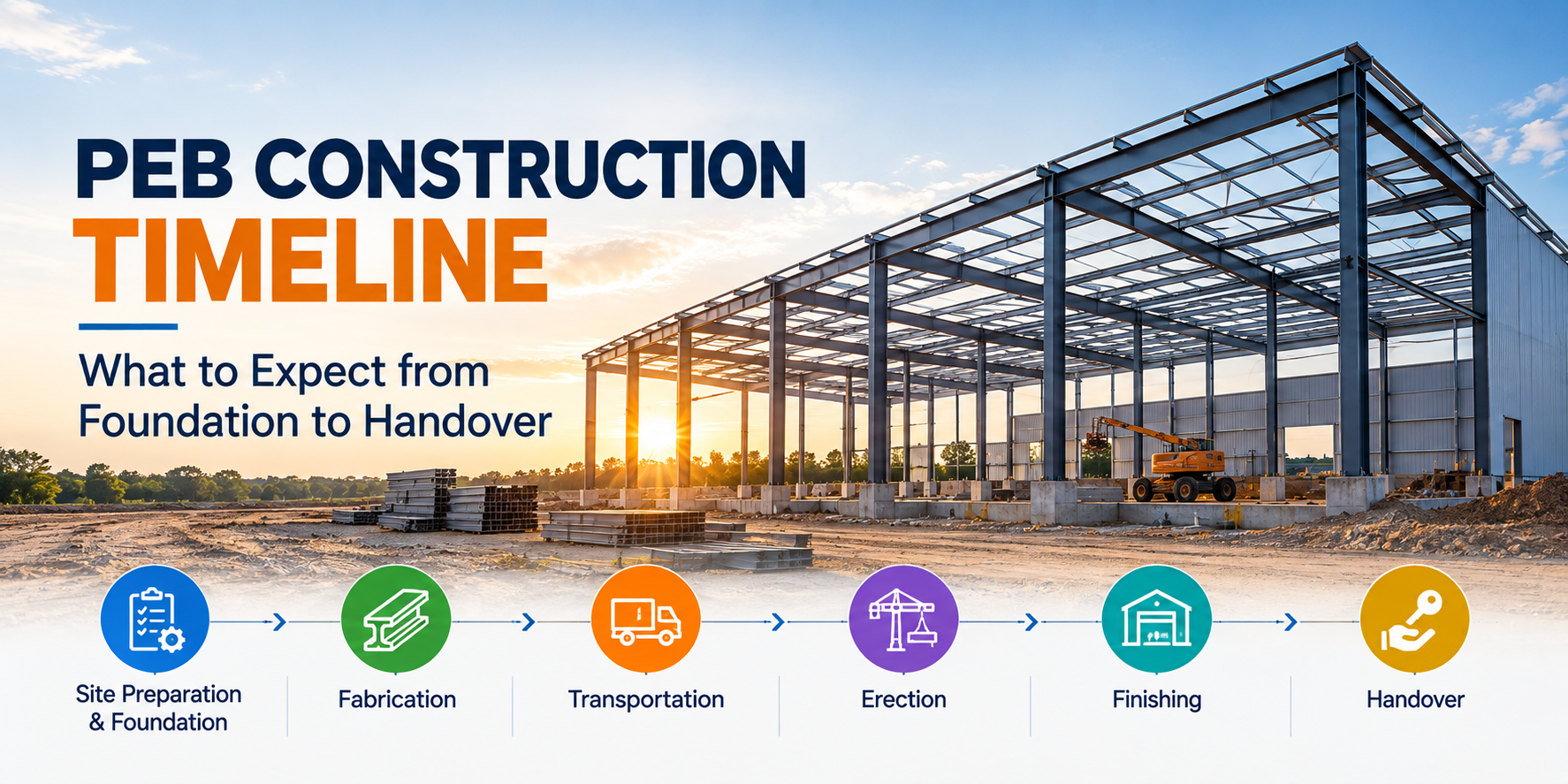
Introduction
One question comes up in almost every first conversation with a prospective PEB buyer, and it’s rarely answered clearly: “Okay, but how long will this actually take — step by step?” Vague answers like “a few months” or “faster than conventional construction” are technically true, but they don’t help a business plan around a real opening date, production deadline, or event season.
This article walks through what actually happens between signing a contract and receiving handover of a pre-engineered building — so buyers evaluating factory sheds, warehouses, or large-span commercial structures know what to expect at each stage, and what genuinely affects the timeline.
Why Buyers Rarely Get a Straight Answer on Timeline
Most construction quotations lead with a single headline number — “3 to 4 times faster than conventional construction” — without breaking down where that time actually goes. That’s not dishonest, but it leaves a gap: a buyer signing a contract wants to know what happens in month one, month two, and so on, not just the total.
The honest answer is that a PEB timeline has several distinct stages, some of which run in parallel and some of which depend on site-specific factors like approvals, soil conditions, and design finalization. Understanding those stages is what turns a vague promise into a plan you can actually build a business decision around.
The PEB Construction Process, Stage by Stage
1. Design and Structural Engineering
The project starts with finalizing layout, load requirements (machinery, racking, crane capacity, wind and seismic factors for the region), and structural drawings. This stage sets the steel grade, section specification, and bay/span dimensions — decisions that shape everything downstream, so rushing it tends to cause delays later, not save time now.
2. Foundation and Civil Work
Once drawings are approved, site foundation and civil work begins. This is also the point where structural steel fabrication starts in parallel, rather than waiting for the foundation to be complete first — this overlap is the single biggest reason PEB timelines are shorter than conventional construction.
3. Factory Fabrication
Structural steel components are fabricated off-site in a controlled factory environment, to the exact engineering drawings finalized in stage one. Dimensional accuracy, weld quality, and coating are checked before anything leaves the factory — which is also where documented steel grade should be verifiable, not just promised.
4. Transport and Site Mobilization
Fabricated components are transported to site and staged for erection, timed so that steel typically arrives once the foundation is ready to receive it — not before, and not with a long gap after.
5. Erection and Assembly
This is the stage most people picture when they think of “fast” PEB construction — and it genuinely is fast, because it’s assembly of pre-fabricated, quality-checked components rather than building from raw material on-site. Columns, rafters, purlins, and roofing go up in a sequence engineered for efficient assembly.
6. Finishing and Handover
Cladding, insulation, doors, ventilation, flooring, and any interior finishing (critical for spaces like banquet halls or office areas within a warehouse) are completed, followed by final inspection and handover. For structures with a premium finish requirement, this stage takes real time and shouldn’t be compressed just to hit a headline date.
Why the Overall Timeline Is Still 3 to 4 Times Faster
Add up the stages above and the time savings don’t come from skipping steps — they come from stages 2 and 3 running in parallel instead of sequentially, and from stage 5 being fast because the components arriving on-site are already fabricated and quality-checked, not raw material waiting to be built from scratch.
For manufacturers, warehouse operators, and venue owners across Nashik, Odisha, and the greater Mumbai region working against a real deadline — a production start date, a distribution contract, a wedding season — this is the part of the process that actually protects the business case, not just the construction budget.
What Can Still Cause Delays
A realistic timeline conversation should also cover what can push a schedule back, because pretending nothing can go wrong doesn’t serve anyone:
- Design changes requested after fabrication has started, which can require re-work on already-cut steel
- Delays in statutory approvals or clearances that are outside the builder’s control
- Site access or soil conditions discovered only once foundation work begins
- Monsoon timing in regions with a heavy seasonal weather window
A transparent provider will flag these risk points at the start of the project rather than only when they happen — that’s usually a better signal of reliability than the headline speed number alone.
Typical Stage Durations for a Mid-Size Industrial Structure
Exact timelines vary by structure size, span, region, and finishing scope, but the table below gives a general sense of how the stages typically compare in proportion to each other:
| Stage | Relative Share of Timeline |
| Design & Engineering | Early, fixed duration — sets up everything else |
| Foundation + Fabrication (parallel) | Largest combined stage, runs simultaneously |
| Transport & Erection | Fast — assembly of pre-fabricated components |
| Finishing & Handover | Varies most, depending on interior finish scope |
Questions to Ask About Your Project Timeline
- What does the timeline look like stage by stage, not just as a single total number?
- When does fabrication start relative to foundation work — are they actually running in parallel?
- What structural steel grade and specification will be documented before fabrication begins?
- What are the known risk points for this specific site, and how are they being planned for?
- What does the finishing and handover stage include, and how long does that typically take separately from erection?
Frequently Asked Questions
How long does a typical PEB project take from contract to handover?
It depends on structure size, span, and finishing scope, but the overall timeline is typically 3 to 4 times faster than conventional RCC construction, largely because fabrication and foundation work happen in parallel rather than sequentially.
Can construction start before the design is fully finalized?
Foundation work can begin once civil drawings are approved, but structural steel fabrication should only start once the engineering design is finalized — starting fabrication too early against an unfinalized design is a common source of costly rework.
Does a faster timeline mean less quality control?
No — quality checks happen earlier in the process, not less often. Dimensional accuracy, weld quality, and coating are verified in the factory before components reach site, which is a different (and in some ways more controlled) quality process than open-air on-site fabrication.
What’s the most common cause of delay in PEB projects?
Design changes requested after fabrication has started. Finalizing layout, load requirements, and structural drawings before fabrication begins is the single biggest thing a buyer can do to protect their own timeline.
The Takeaway
A construction timeline shouldn’t be a single number taken on faith. Buyers who understand the actual stages — design, parallel foundation and fabrication, erection, and finishing — are in a much better position to plan around a real deadline, and to spot the difference between a provider who has genuinely engineered an efficient process and one who’s simply quoting an optimistic headline.
Planning a project with a hard deadline? Talk to Urwish about a stage-by-stage timeline for your factory, warehouse, or commercial structure — before you finalize your construction approach.
About Urwish Engineers Pvt Ltd
Urwish Engineers Pvt Ltd is a pre-engineered building and prefabricated structure manufacturer serving factory, warehouse, and commercial construction projects across Nashik, Odisha, and the greater Mumbai region.
From design and documented steel specification through parallel foundation work, factory fabrication, and on-site erection, Urwish Engineers plans every stage of the timeline upfront — so buyers know what to expect, not just how fast the headline number sounds.
Contact Urwish Engineers Pvt Ltd today to get a stage-by-stage timeline for your next project.